
You connect GoMeddo Payments to Adyen in two parts: you create an API key in Adyen, and you add Adyen as a payment provider in GoMeddo. GoMeddo Payments then sets up the webhook in Adyen for you.
Before you start
-
You have the GoMeddo Payments Admin permission set.
-
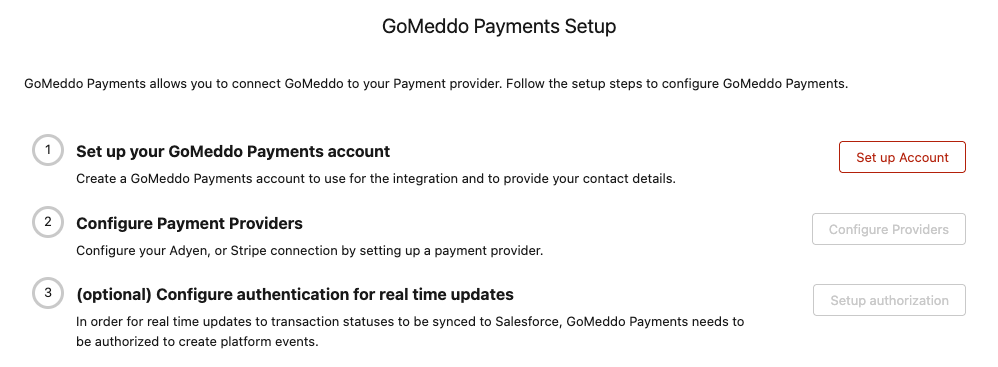
You have set up your GoMeddo Payments account: in GoMeddo Settings > Payments, click Set up Account.
The Payments page in GoMeddo Settings looks like this:
Create an API key in Adyen
-
Log in to your Adyen dashboard.
-
In the sidebar, click Developers > API credentials.
-
Click Create Credential, then click Save.
-
Click Generate new API key, copy the key and click Save API key.
-
Give the credential access to the webhooks of the Adyen Management API, so GoMeddo Payments can create the webhook.
-
Note the name of your merchant account. You need it with the API key in the next section.
Add Adyen as a payment provider
-
In the GoMeddo app, go to GoMeddo Settings > Payments.
-
Next to Configure Payment Providers, click Configure Providers.
-
Click Add Provider.
-
In Provider Options, select Adyen and click Next.
-
Fill in the fields:
-
provider_name: the name of the provider in GoMeddo, for example Adyen Test #1.
-
merchant account name: the name of your Adyen merchant account.
-
platform:
testfor your Adyen test environment orlivefor your live environment. -
live_endpoint_prefix: the prefix of your live Adyen endpoint. For
https://abc123-live.adyenpayments.comthe prefix isabc123. -
x_api_key: the API key you copied in Adyen.
-
-
Click Validate. GoMeddo Payments checks the API key and the merchant account with Adyen.
-
Click Next, check the summary and click Submit. You see the message Payment Provider created successfully.
GoMeddo Payments now creates a standard webhook in your Adyen merchant account, with its own user name and password. You do not have to set up the webhook yourself.